Dryer repair in Kuna, heat and airflow both checked
A dryer in Kuna that tumbles for ninety minutes and hands back damp jeans, a drum that thumps on every turn, a burnt smell from upstairs.
$99 to diagnose — folded into the repair once you say yesON THE TRUCK Same-week for no heat20 MIN from Davis Ave · the drive never shows on the invoice
Kuna’s dryers have long vents. In the two-story houses off Ten Mile Rd and Hwy 69 the laundry room is upstairs and the vent runs down through a wall, across a floor cavity and out a wall cap somewhere the builder found convenient, which can add up to thirty feet of pipe and three elbows. Every elbow slows the exhaust, and a dryer that was marginal on installation day loses the fight the first time the lint filter is skipped. Add the wind off the desert south of Swan Falls Rd carrying dust and thistle, and the wall cap flap is often held half open by grit and half shut by lint.
A hundred different streets produce the same call: the dryer heats, but the load takes two runs. The thermal fuse on an electric dryer opens when the exhaust backs up and the heat has nowhere to go, and from then on the drum spins cold. A gas dryer under the same conditions lights, overheats at the high-limit and shuts the burner down, over and over, drying nothing. On the acreage side the vents are shorter but the dust is worse, and the blower wheel packs solid. We replace the failed part and then measure airflow at the wall, because a fuse that goes once will go again if the duct is still choked.
What the symptom usually means
Cold air, drum turning
On electric: an open thermal fuse, a broken heating element or a failed thermostat, metered in that order. On gas: an igniter that never glows, a flame sensor that will not close, or valve coils that have weakened. Replaced from the truck, and the vent measured before we call it done.
Warm, but never dry
Restricted airflow. A vent run that is too long, a flex hose flattened against the wall behind the dryer, lint packed at an elbow, a blower wheel loaded with dust. We measure exhaust at the wall cap, clear the reachable part from the dryer end, and give you a straight yes or no on whether the duct through the house needs a rod-and-vacuum cleaning.
Thump or squeal with every rotation
Drum support rollers worn flat, an idler whose bearing has run dry, or metal-on-metal at the rear drum bearing. Rollers and idlers are replaced as a set on most models, since a new roller beside a worn one just moves the noise. The belt gets replaced at the same time if it shows cracking.
Shuts off early, restarts later
The high-limit thermostat is tripping on a plugged exhaust, or the motor has a weak centrifugal switch and drops out under load. We meter the thermostat and the motor and check airflow before choosing, because a dryer that overheats on a blocked duct will do it again with a new thermostat.
Motor hums, drum stays still
The belt has snapped, or a seized roller is holding the drum against the motor. Occasionally the blower wheel is jammed with a sock that got past the filter. We replace the belt or the roller, clear the blower and confirm the motor pulls normal current afterward.
Scorched smell or brown marks on clothes
Lint has piled up on the heating element or around the burner and has begun to char, or the cycling thermostat has failed closed and the dryer is running far too hot. Stop using it. We clean the heater housing, replace the failed thermostat and check the exhaust temperature before handing it back.
The procedure
Fuse, element or igniter, and thermostats metered before any part is named
Airflow measured at the wall cap, upstairs runs traced to the exit
Repair price in writing, one figure, with the $99 already in it
Fuses, elements, igniters, rollers, idlers and belts carried on the truck
A load-in timed cycle before we leave, warranty written on the invoice
How dryer repair in Kuna runs
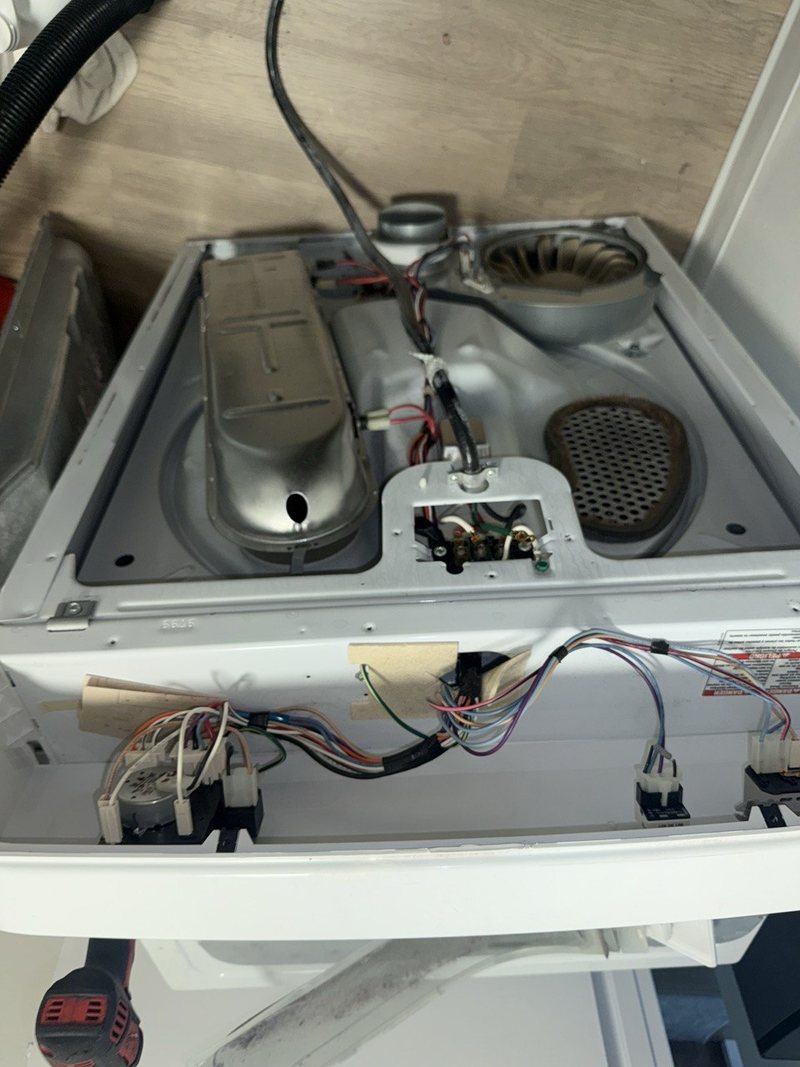
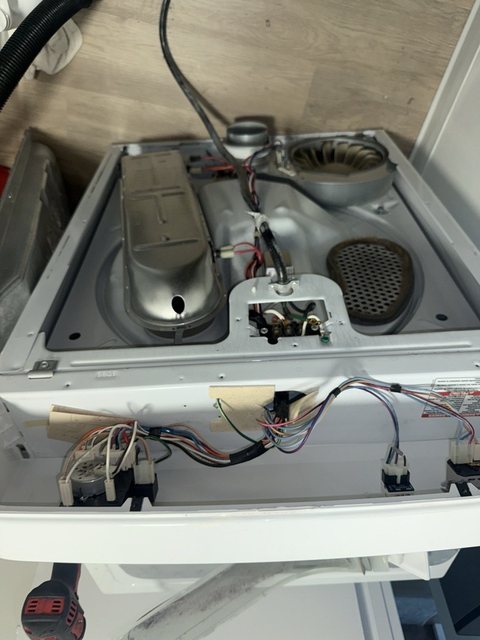
The front or the back comes off, and the thermal fuse gets the meter first, then the element or the igniter, then the thermostats. On a gas dryer the technician watches the igniter through the burner opening: does it glow, does the flame light, does it stay lit. That sequence names the part on nearly every no-heat dryer in Kuna without guessing. The second half of the visit is airflow. A flow meter at the wall cap says whether the vent is moving enough air, and on a two-story house with the laundry upstairs it often is not. We clear the reachable stretch and say plainly when the run needs a duct specialist with rods, rather than pretending our brush got to the end of the pipe.
The dryers along Ten Mile Rd and Deer Flat Rd are mostly Whirlpool and GE builder pairs, with Samsung, LG, Maytag, Frigidaire, Kenmore, Amana, Electrolux and Speed Queen mixed in on the older acreage streets, and we repair all of them, gas and electric. Boise commuters take the first slot of the morning and are on the road before the repair is cold. A rental off Hwy 69 can be approved by text, and the owner receives the invoice and warranty in email. Gas work finishes with every joint leak-checked. And the price rule holds: $99 to diagnose, counted inside the repair when you approve it, every dryer repair in Kuna priced after the meter and written down before a part is touched.
Dryer repair in Kuna: $99 for the diagnosis and the airflow reading, a figure that disappears into the repair price when you go ahead. If the dryer is not worth fixing, the $99 is where it ends. Request service →
Asked in Kuna
My Kuna dryer is only two years old and already will not heat. Why?
Usually the vent, not the dryer. A long upstairs run in a new two-story house restricts airflow from day one, the thermal fuse opens when heat backs up, and the machine runs cold from then on. We replace the fuse, then measure the exhaust, and the airflow number tells you whether the duct needs attention before it happens again.
Can you clean a dryer vent that runs through two floors?
From the dryer end and the wall cap we clear what our tools reach, and we measure the result. A thirty-foot run with elbows in a floor cavity sometimes needs a full rod-and-vacuum cleaning from a duct specialist, and we say so instead of guessing. The dryer repair still gets done; the vent advice comes with it.
Is there gas dryer service on the acreage south of Kuna?
Yes. Houses out Swan Falls Rd and toward the desert are usually on propane rather than Intermountain Gas, and a dryer set up for the wrong fuel burns yellow and soots the drum. We check the orifice and the flame, replace igniters and coils, and leak-check every fitting before the burner runs unattended.
What makes the wall cap ice over in January?
Warm exhaust hitting a cold cap condenses on the lint already stuck there, and the plug builds from outside in. A cap on the north side of a house in Kuna, with a foggy inversion sitting over the valley for a week, will freeze shut faster than one in the sun. A smooth run and a clean cap flap are the fix, and neither is a dryer part.
What is included in the $99 on a dryer call?
A technician at the dryer with a meter, the failed part identified in plain words, the vent airflow measured at the wall, and a repair price in writing. Approve that price and it already contains the $99. Decline it, and the visit ends at $99 with the written diagnosis in your hand.
The phone is quicker; the form lands on the same desk. Both get you a text with a window, and until a technician has had a meter on the machine the only figure anyone quotes is $99.
Window texted to you; the technician will call if you would rather talk
$99 buys the meter reading and the diagnosis — no money before that
The repair as one written figure, $99 folded in
Warranty term printed on the invoice
How a visit runs
Four steps, and no step five on the invoice
1
Window
Ring the shop or fill in the form; dispatch answers with a window, and a text follows as the truck pulls off Davis Ave — first stops go to the Boise commuters, Saturday mornings to everyone else.
2
Meter
Measurements come before opinions: amps at the compressor, degrees on the shelf, ohms across the element. The failed part gets its everyday name from the technician, who then writes the repair as a single figure, $99 folded in.
3
Part
The shelves on the truck hold what this valley wears out — inlet valves, defrost heaters, heating elements, igniters, drain pumps, rollers. When something must be ordered, the return trip happens on our calendar and the figure you approved stands.
4
Proof
The machine runs a whole cycle while you watch, panels and floor go back the way they were, and the invoice that reaches your email carries the warranty term.
Dryers in Kuna — one written number, fixed once.
$99 puts a meter on the machine. The repair goes on the ticket as one figure with that $99 inside it, the part is usually riding in the truck, and the invoice states the warranty term. Parma pays what Davis Ave pays.