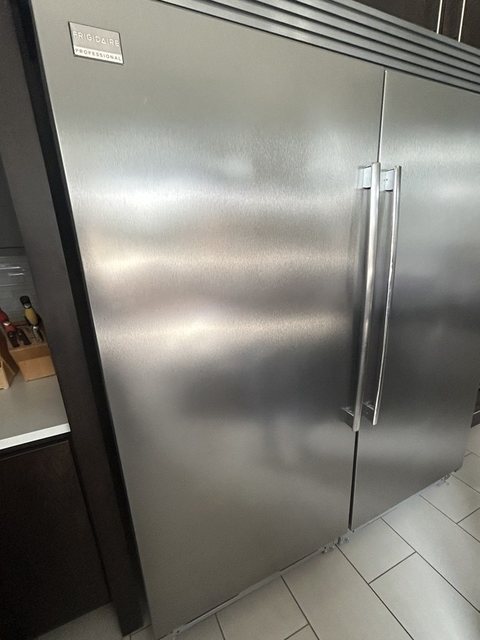
Refrigerators & freezers · kitchen and garage · Nampa
Refrigerator repair in Nampa that finds the cold again
Warm shelves, a freezer growing a frost bank, a compressor that clicks and quits: refrigerator repair in Nampa starts with a thermometer and a meter, never a hunch.
$99 to diagnose — folded into the repair once you say yesON THE TRUCK Same-day for a warm refrigerator before noonTODAY a warm refrigerator reported before noon jumps the line
The truck loads on Davis Ave, a few blocks off the old grid, and the refrigerator calls sort themselves by the map. Downtown and the NNU blocks have narrow kitchens with the unit shoved into an alcove built for a smaller box. North Nampa off Cherry Ln and Can-Ada Rd runs to builder-package French doors, ten years old and out of the maker’s coverage. South past Greenhurst Rd and Lake Lowell Ave the acreage starts, and with it the garage refrigerator and the chest freezer full of beef. Caldwell, Middleton and Kuna are short legs up I-84 or out Deer Flat Rd; Melba, Marsing and Parma are the long ones, and nothing about the drive lands on your invoice.
July does most of the damage. When the garage sits at 105°F for a week, a condenser coil furred with cottonwood fluff and field dust cannot shed heat, the compressor works hot for hours at a stretch, and one afternoon the overload trips and stays tripped. The same coil in a Kuna subdivision kitchen fails quieter: the fresh-food side drifts to 45°F and the milk goes off early. The other classic is the frost bank. A defrost heater or defrost thermostat opens, the evaporator ices over in a week, air quits circulating, and the fresh-food side warms up while the freezer holds. Both get measured, not guessed at.
Reading the refrigerator’s symptoms
Refrigerator warm, freezer still cold
Nine times out of ten the evaporator is iced solid and the air path is blocked. The back panel comes off, the ice pattern tells its story, and the meter goes across each piece of the defrost circuit: heater, thermostat, control. The failed part is usually on the truck, the coil gets thawed, and the box is cooling before we leave.
Both sides warm, compressor humming or clicking
A click every so often with no run is a start relay or overload; a steady hum with nothing getting cold can mean a seized compressor or a sealed-system fault. Amperage and winding resistance get measured right at the terminals, and you hear plainly which one it is before any part is ordered.
Runs all the time and never gets cold enough
Suspect a dust-packed condenser, a stalled condenser fan, or a gasket that leaks garage air all night. The coil gets cleaned, the fan motor tested, the gasket seal checked with a strip of paper, and confirm the box pulls down to temperature on a thermometer before calling it done.
Puddles in the crisper bin or out on the floor
Water at the bottom is a plugged defrost drain that freezes into a plug, or a cracked drain pan. Water on the floor in front is the water inlet valve or a split fill line behind the unit. We clear the drain, replace the valve if it seeps, and dry the cabinet floor.
Garage refrigerator quit in the heat or thawed in the cold
Garage units fail in two seasons. In August the coil cannot dump heat into a hot garage. In January a 35°F garage keeps the compressor off, so the freezer side thaws. We test the thermostat and compressor, clean the condenser, and tell you if the unit is worth carrying through another summer.
Loud fan, rattle or a grind from the back
A grinding evaporator fan usually has ice on the blades or a worn motor; a rattle at the back is the condenser fan hitting a shroud or a loose compressor mount. With the panels off the noise gives itself away; a motor with a spent bearing gets replaced and the unit goes quiet.
The procedure
Thermometer on the shelf and a meter on the compressor before any opinion
A plain name for what failed, one number on paper, $99 folded in
Defrost heaters, relays, fan motors and inlet valves stocked on the truck
A part on order means we come back at the same number, no second fee
Full pull-down check, panels back on, written warranty on the invoice
How refrigerator repair in Nampa runs
We start with the numbers. A thermometer goes on the fresh-food shelf and another in the freezer, and while the panels come off the technician is listening: compressor, evaporator fan, condenser fan. The condenser gets a light; a coil you cannot see through is the first finding. Then the meter: amperage draw at the compressor, resistance across the defrost heater, continuity through the defrost thermostat, voltage at the fan. A compressor that draws current but moves no heat is a sealed-system problem, and that is what we call it instead of selling a control board. Name the failed part, put one number on paper, and the choice is yours.
Most of what we open is Whirlpool, GE, Frigidaire, Samsung, LG and Kenmore, with Maytag and Amana in the older houses and Bosch or KitchenAid in the remodels. A lot of these refrigerators belong to someone who is not standing in front of them: a rental near NNU, a second place out by Lake Lowell, a house in Middleton whose owner is at work in Boise until six. Whoever is home opens the door; the owner sees a photo, texts back a yes, and email carries the invoice and warranty to wherever they are. Pricing works the same for all of them: the meter comes first, the figure goes on paper second, and the $99 was never a separate line because it is built into that figure.
Refrigerator repair in Nampa and Canyon County: a $99 diagnosis that becomes part of the repair figure on a yes, and stands as the whole charge on a no. Request service →
Asked in Nampa & Canyon County
How fast can a warm refrigerator in Nampa get a technician?
A warm refrigerator reported before noon is the job the day gets rearranged around. The dispatcher texts an arrival window, and the technician brings the parts that most often fix a no-cool call. Later calls get the next open window, usually the following morning.
Is it worth repairing a garage refrigerator that quit in August?
Often, yes. On a box with years left, a furred condenser, a fan motor or a start relay is a small job. A compressor that has lost its winding on a twenty-year-old box is not. The $99 diagnostic tells you which, and the number is written before you decide.
Do you service refrigerators outside Nampa city limits, on well water?
Yes. Well water matters mostly to the ice maker and water dispenser, where scale narrows the inlet valve and the fill tube. Melba, Wilder, Marsing and the acreage south of Lake Lowell are ordinary stops, and there is no mileage charge on the invoice.
Why is my freezer growing frost and the refrigerator side getting warm?
That pattern is the defrost system. When the heater, the thermostat or the control stops running the defrost cycle, the evaporator coil ices over and air can no longer move up to the fresh-food side. We meter each of the three, replace the one that failed, and thaw the coil.
What does a Canyon County refrigerator repair cost before you look at it?
Nothing is quoted before the meter goes on the machine, because a guess would be wrong half the time. You pay $99 for the answer. Approve the work and that paper figure already contains your $99. Pass, and you owe $99 and keep the explanation.
Refrigerators and freezers in Nampa and Canyon County: get a window.
The phone is quicker; the form lands on the same desk. Both get you a text with a window, and until a technician has had a meter on the machine the only figure anyone quotes is $99.
Window texted to you; the technician will call if you would rather talk
$99 buys the meter reading and the diagnosis — no money before that
The repair as one written figure, $99 folded in
Warranty term printed on the invoice
How a visit runs
Four steps, and no step five on the invoice
1
Window
Ring the shop or fill in the form; dispatch answers with a window, and a text follows as the truck pulls off Davis Ave — first stops go to the Boise commuters, Saturday mornings to everyone else.
2
Meter
Measurements come before opinions: amps at the compressor, degrees on the shelf, ohms across the element. The failed part gets its everyday name from the technician, who then writes the repair as a single figure, $99 folded in.
3
Part
The shelves on the truck hold what this valley wears out — inlet valves, defrost heaters, heating elements, igniters, drain pumps, rollers. When something must be ordered, the return trip happens on our calendar and the figure you approved stands.
4
Proof
The machine runs a whole cycle while you watch, panels and floor go back the way they were, and the invoice that reaches your email carries the warranty term.
Refrigerators and freezers in Nampa and Canyon County — one written number, fixed once.
$99 puts a meter on the machine. The repair goes on the ticket as one figure with that $99 inside it, the part is usually riding in the truck, and the invoice states the warranty term. Parma pays what Davis Ave pays.