Dryers · gas and electric · stacked pairs · North Nampa
Dryer repair in North Nampa for cold tumbles and long cycles
Towels that are still damp an hour in, a cold drum going round, a squeal audible from the kitchen.
$99 to diagnose — folded into the repair once you say yesON THE TRUCK Same-week windows, often next day7 MIN from Davis Ave · the drive never shows on the invoice
Dryers in the two-story houses north of the freeway
Dryers · North Nampa
A dryer in North Nampa usually sits upstairs. The subdivisions off Cherry Ln, Ustick Rd and Can-Ada Rd were built with the laundry on the second floor or in a closet off the garage, and the vent runs a long way through the wall and the attic before it reaches daylight. That run is where most of the trouble starts. The machines are the builder-package Whirlpool, GE and Frigidaire electrics, with a share of gas units where Intermountain Gas was stubbed in, and a lot of stacked pairs. The truck comes up from Davis Ave over the Franklin or Garrity exit and can be on Ustick before the school traffic clears.
Dust is the local enemy. Field dust, construction dust from the next phase of the subdivision, and cottonwood fluff off the canal find their way into the lint screen housing and the vent, and a half-plugged vent makes a dryer run long, run hot and trip its thermal fuse. In January the vent hood on a north wall ices shut during the inversion and the same fuse blows. Then there is plain wear: rollers and glides on a dryer that has done ten years of kids’ clothes squeal, and the belt lets go on a Tuesday. Every one of those failures points to a particular part, and the truck stocks the usual ones for the brands in these houses.
What the dryer is doing and why
Drum spins but stays cold
Electric dryer: the element itself, a thermal fuse that blew, or a high-limit thermostat that opened. Gas dryer: the igniter, flame sensor or one of the gas valve coils. The meter reads each one open or closed. We replace the failed piece and then find out why the fuse blew, which is usually the vent.
Heats, but a load takes two cycles
Airflow. Somewhere between the machine and the roof cap the vent has filled with lint and dust, or the blower wheel has loosened. Airflow gets measured at the exhaust, we clear the section within reach, and you hear from us whether the attic run needs a proper cleaning.
Squeal or thump that carries through the house
Worn drum rollers, a worn idler pulley or worn rear glides. In a second-floor laundry closet off Cherry Ln the noise travels through the framing. The front comes off, every roller gets turned by hand, and the whole set plus the belt goes in new while the drum is sitting out.
Stops a short way into the cycle
A thermal fuse tripping on heat, a motor overheating from a plugged vent, or a door switch that loses contact whenever the drum shakes. We check the vent first, then meter the fuse and the motor windings. A motor that runs hot and stops is not always a motor; it is often a blower packed with lint.
Gas dryer glows orange, then loses the flame
The igniter comes up to color but the valve coils never open, or a failed flame sensor shuts the burner down after the first few seconds. Those coils are a resistance check. We replace the coil set or the sensor and watch the burner run through a full cycle.
Burnt smell from the laundry closet
Scorching lint, packed on the element or around the burner. Leave the dryer off. We take the drum out, vacuum the heater box and blower clean, and check the element for a sag that touches the housing. This one is why the vent check comes with every call.
The procedure at the dryer
Heat-side parts read on the meter before anyone names a part.
Vent airflow measured at the exhaust on every North Nampa dryer call.
The repair written as a single number that already contains the $99.
Elements, fuses, igniters, rollers and belts for the builder brands on the truck.
Full drying cycle timed and checked, machine restacked, written warranty on the invoice.
Dryer repair in North Nampa, how it goes
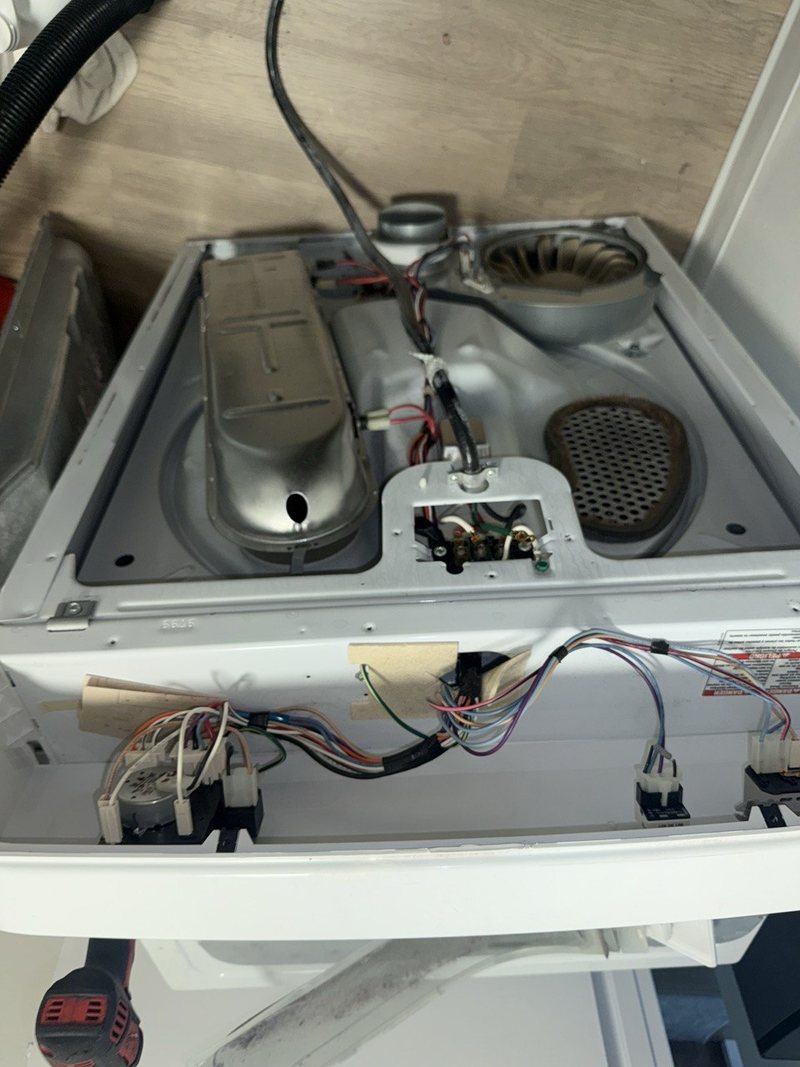
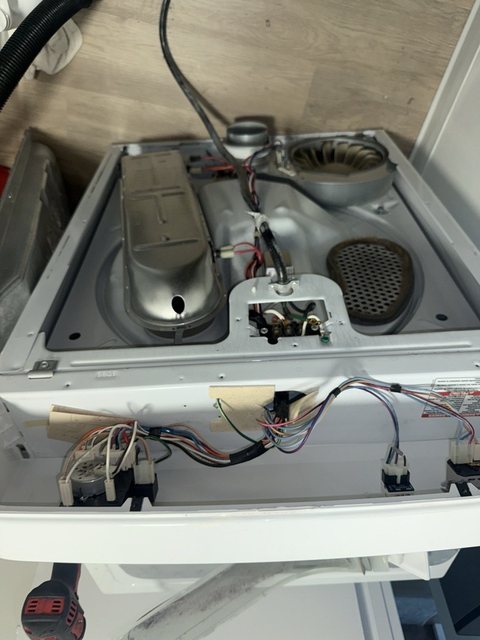
The dryer is run first, with the technician’s hand on the exhaust. Weak air at the vent means the problem is downstream, and a plugged duct does not care how many new parts go in. Then the cabinet opens. Electric unit: element, fuse, cycling thermostat and high-limit each give a resistance reading. Gas unit: igniter, flame sensor and valve coils give the same. The drum comes out if the noise complaint calls for it, and the idler and every roller get spun by hand. The stacked pairs common in North Nampa closets are unstrapped and pulled to do this properly. The failed part gets a name and the repair gets one written number.
We service gas and electric dryers from Whirlpool and Maytag, from GE, Samsung and LG, from Frigidaire, Electrolux, Kenmore, Amana and Speed Queen, including the laundry-center units. Nurses and techs from St. Luke’s and Saint Alphonsus who sleep during the day can ask for a late-afternoon window; Boise commuters get the first stop or a Saturday morning. Rental owners near the Idaho Center okay the work from their phone; the paperwork, warranty included, lands in their inbox. Most dryer parts are stock, so the repair happens on the first visit; when a part must be ordered, our second trip costs nothing extra. A dryer repair is priced only after the diagnostic, on paper. Approve that number and the $99 folds into it; walk away and the entire tab is $99.
A dryer diagnostic in North Nampa is $99, and approving the written repair figure folds that $99 into it. Turn the repair down and your total stays at $99. Request service →
Asked in North Nampa
Is vent cleaning part of a North Nampa dryer call?
From the machine end we clear whatever we can reach, and the exhaust airflow gets measured every time, because in the two-story houses off Ustick Rd a plugged vent explains most of the no-heat and long-cycle complaints. If the run through the attic needs a full cleaning we tell you, and we do not put in a new fuse and leave a bad vent behind.
Is a North Nampa gas dryer different to repair?
The drum, rollers, belt and motor are the same. The heat side is different: an igniter, a flame sensor and gas valve coils instead of an element. Intermountain Gas serves the subdivisions north of I-84, so we see both kinds every week and carry the parts for each on the truck.
My dryer works but the clothes take forever. Is that something you fix?
Usually it is airflow, and the repair is the vent, not the dryer. Sometimes it is a cycling thermostat opening too early, or a blower wheel that has worked loose on its shaft. The airflow test and the meter tell those apart in the first part of the visit.
Does a stacked dryer have to come apart for a repair?
No, and we do not try. A stacked pair gets unstrapped and pulled so the front can come off and the drum can come out. It is restacked, strapped and leveled before we leave. Say it is stacked in the request so the technician arrives with the dolly and the time.
What does the $99 get me?
A technician at the dryer with a meter, the vent airflow measured, the broken part identified in plain words, and a repair figure in writing. Give the go-ahead and that $99 is already folded into the figure. Pass on the repair and the visit costs $99, nothing else.
The phone is quicker; the form lands on the same desk. Both get you a text with a window, and until a technician has had a meter on the machine the only figure anyone quotes is $99.
Window texted to you; the technician will call if you would rather talk
$99 buys the meter reading and the diagnosis — no money before that
The repair as one written figure, $99 folded in
Warranty term printed on the invoice
How a visit runs
Four steps, and no step five on the invoice
1
Window
Ring the shop or fill in the form; dispatch answers with a window, and a text follows as the truck pulls off Davis Ave — first stops go to the Boise commuters, Saturday mornings to everyone else.
2
Meter
Measurements come before opinions: amps at the compressor, degrees on the shelf, ohms across the element. The failed part gets its everyday name from the technician, who then writes the repair as a single figure, $99 folded in.
3
Part
The shelves on the truck hold what this valley wears out — inlet valves, defrost heaters, heating elements, igniters, drain pumps, rollers. When something must be ordered, the return trip happens on our calendar and the figure you approved stands.
4
Proof
The machine runs a whole cycle while you watch, panels and floor go back the way they were, and the invoice that reaches your email carries the warranty term.
Dryers in North Nampa — one written number, fixed once.
$99 puts a meter on the machine. The repair goes on the ticket as one figure with that $99 inside it, the part is usually riding in the truck, and the invoice states the warranty term. Parma pays what Davis Ave pays.