Dishwashers · builder packages · hard water · North Nampa
Dishwasher repair in North Nampa that leaves the tub empty
Water pooled in the tub every morning, chalky glasses, a panel with no lights. In North Nampa the dishwasher gets the pump, valve and element metered, the softener asked about, and one written number.
$99 to diagnose — folded into the repair once you say yesON THE TRUCK Builder Whirlpool, GE and Frigidaire units7 MIN from Davis Ave · the drive never shows on the invoice
Nearly every kitchen in the subdivisions off Cherry Ln, Ustick Rd and Can-Ada Rd got the same dishwasher the day the house closed: a Whirlpool, GE or Frigidaire from the builder package, installed by the trim crew and plumbed into hard Nampa city water through a softener in the garage. Ten years on, those machines make up most of our calls north of the freeway. The truck comes over the Franklin or Garrity exit from Davis Ave and works the streets behind the Idaho Center and around the two hospitals, where a dishwasher that stops on a Tuesday matters to a household on shift work.
Hard water sets the pattern here. Let the softener salt run down and the dishwasher announces it before any other machine in the house: every glass wears a white film, the heating element grows a chalk ring, half the holes in a spray arm plug up. No part is broken in that case, and you get told so rather than sold something. The real failures are a drain pump or check valve leaving water behind in the tub, the inlet valve that scales up and fills slowly, the door latch and the control on the newer touch panels, and the circulation pump that gets loud after a decade of scale. Most of those are on the truck for the builder brands.
What the dishwasher is telling you
Tub holds water once the cycle ends
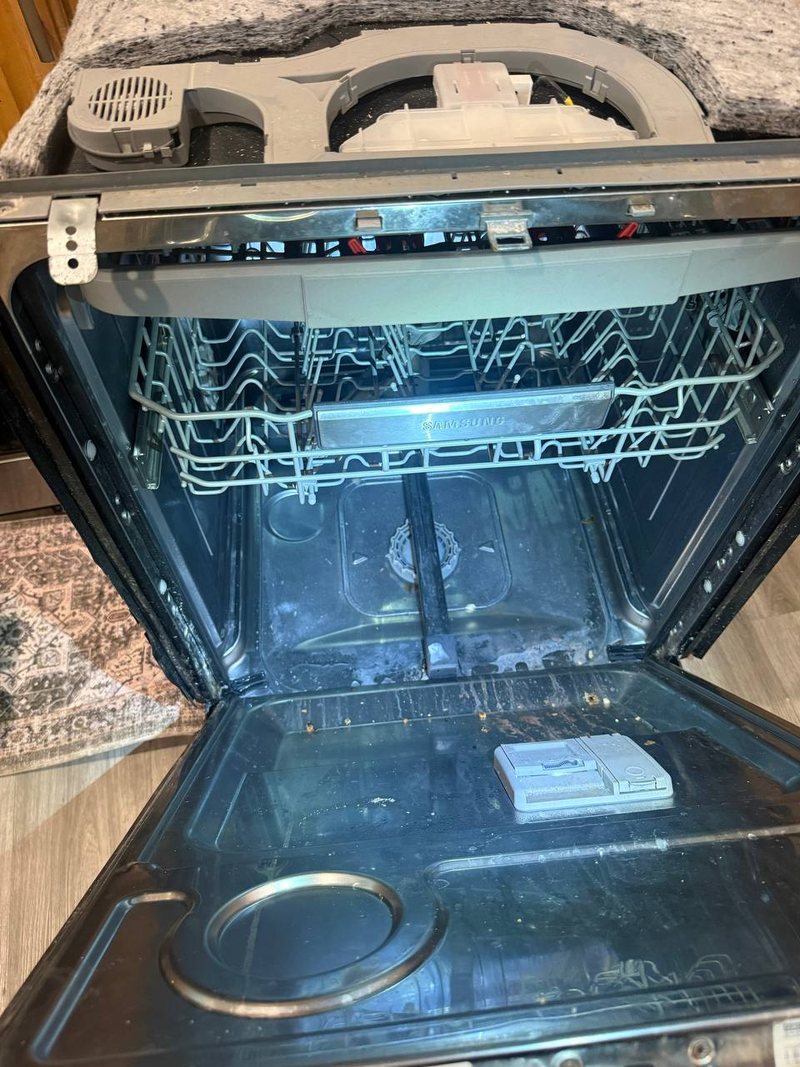
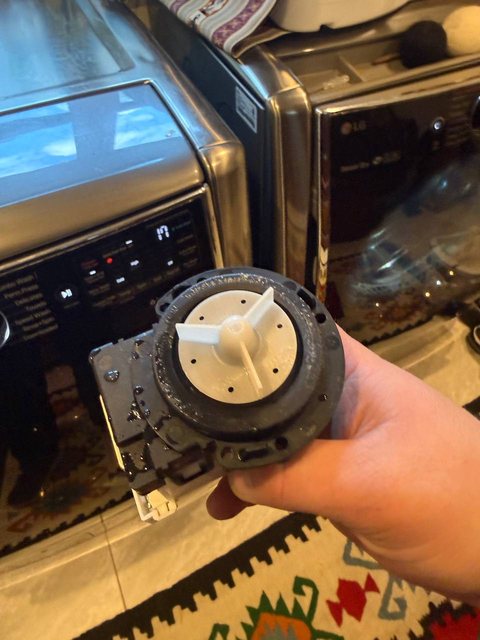
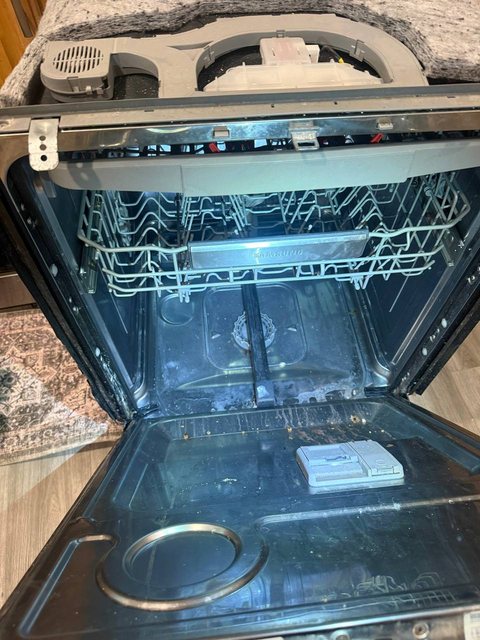
Either the drain pump is jammed or dead, the check valve has stuck, or someone looped the drain hose wrong under the sink. Off comes the sump cover; the pump gets cleared and metered, and the high loop and air gap get a look. A glass shard in the pump is the most common find.
White film on glasses and a chalky element
Hard water, most often because the softener needs salt or was programmed wrong. We check the element for scale and the arms for plugged holes and tell you what to run through it. If the element or the heater circuit reads open on the meter, that is a real repair and gets a written number.
Dishes still dirty at the end
Spray arms plugged with scale or food, a circulation pump that no longer builds pressure, or a wash motor humming but never turning. We pull the arms, check the filter and the sump, and meter the motor. On the Frigidaire builder units the lower arm bearing wears and drops the pressure.
Panel dark, buttons do nothing
Power first: the breaker, the junction box under the machine, the door switch. Then the control board and the touch panel. Summer thunderstorm brownouts kill boards in the newer units, and we meter the board’s supply before naming it so a bad door latch is not sold as a board.
Puddle at the front edge or below the door
Door gasket worn flat, a cracked lower seal, a spray arm pointed at the door, or an inlet valve stuck open until the tub overfills. Toe panel off, cycle running, eyes on the sump. The gasket or the valve is replaced from the truck the same visit.
Fills slowly or the cycle stalls early
Scale in the inlet valve, a plugged screen, or a float that has stuck in the up position. The valve solenoid gets metered, clean or replace the screen, and test the float. Slow fill on a North Nampa unit is nearly always scale, and a valve that is replaced without the softener fixed will scale again.
The procedure under the counter
Cycle started with the toe panel off, water and drain watched, not described.
Drain pump, inlet valve, heating element and wash motor metered against spec.
Scale problem told apart from a part problem before anything is sold.
The price goes on paper as one number, the $99 diagnostic inside it.
Complete wash and drain proven, floor wiped, coverage terms written on the invoice.
Dishwasher repair in North Nampa, from symptom to invoice
The technician runs the dishwasher with the lower panel off and watches what it does, because a dishwasher describes its own failure once you can see the sump. Fill is timed and the valve is metered. The drain pump is run by itself and its resistance read. The heating element gets a resistance check and a look for scale. The wash motor is listened to under load. The control is asked for stored fault codes and they are written down before they are cleared. If the complaint is film and the element is chalked white, the answer is the softener and you hear that before anything else. Whatever part failed is described in plain kitchen English, and a single written figure covers the fix.
Whirlpool, Maytag and GE dishwashers, along with Samsung and LG, Bosch and KitchenAid, Frigidaire, Electrolux and Kenmore, are all machines we work on, and the builder units in the Cherry Ln and Ustick Rd subdivisions come up more than any. Landlords with rentals near the Idaho Center give their approval by text; the photo, the invoice and the coverage terms land in their email. Commuters headed for Boise get the first stop; nurses coming off nights can ask for late afternoon. Pumps, valves, elements, gaskets and latches for those brands are on the truck, so most repairs happen on the first visit. No dishwasher repair gets a price until the diagnostic is finished; then it goes in writing as one figure, a figure that already has the $99 tucked into it once you give the nod. Pass on it, and the ticket closes at $99.
Diagnosing a North Nampa dishwasher runs $99; okay the written repair figure and that $99 has already been absorbed into it. When softener salt turns out to be the whole fix, you hear so and $99 is all you owe. Request service →
Asked in North Nampa
My North Nampa dishwasher leaves everything cloudy. Is it broken?
Probably not. Cloudy glasses and a chalky element mean hard water getting through, which most often means the garage softener has run dry of salt or somebody left it on bypass. We check the element and the arms for scale, tell you what to run through the machine, and only name a part if the meter finds one.
Do you service the builder-package dishwashers in the Cherry Ln subdivisions?
They are the majority of our dishwasher work in North Nampa. The Whirlpool, GE and Frigidaire units from 2015 to 2025 share a handful of pumps, valves and latches, and those are stocked on the truck. Should yours still fall under the manufacturer’s own coverage, we lead with that news.
There is water in the bottom every morning. Is that a pump?
Often, but not always. It can be a check valve stuck open, a drain hose whose installer skipped the high loop, letting sink water drift back, or a disposal knockout plug nobody punched out. Each of those gets checked before the pump is metered, and the fix is sometimes no part at all.
Can you come after a brownout killed the panel?
Summer storms and brownouts off Idaho Power take out control boards on the newer touch-panel units. We meter the supply into the board and the door switch first, because a dead panel is sometimes a latch and not a board. If it is the board, you get one written number for it.
How long does a dishwasher repair in North Nampa take?
Most take one visit. The diagnosis runs about half an hour, and when the truck already carries the part, the repair starts right after, with a full wash and drain cycle to prove it. A part we have to order brings us back on a second trip that adds nothing to the figure you already approved.
The phone is quicker; the form lands on the same desk. Both get you a text with a window, and until a technician has had a meter on the machine the only figure anyone quotes is $99.
Window texted to you; the technician will call if you would rather talk
$99 buys the meter reading and the diagnosis — no money before that
The repair as one written figure, $99 folded in
Warranty term printed on the invoice
How a visit runs
Four steps, and no step five on the invoice
1
Window
Ring the shop or fill in the form; dispatch answers with a window, and a text follows as the truck pulls off Davis Ave — first stops go to the Boise commuters, Saturday mornings to everyone else.
2
Meter
Measurements come before opinions: amps at the compressor, degrees on the shelf, ohms across the element. The failed part gets its everyday name from the technician, who then writes the repair as a single figure, $99 folded in.
3
Part
The shelves on the truck hold what this valley wears out — inlet valves, defrost heaters, heating elements, igniters, drain pumps, rollers. When something must be ordered, the return trip happens on our calendar and the figure you approved stands.
4
Proof
The machine runs a whole cycle while you watch, panels and floor go back the way they were, and the invoice that reaches your email carries the warranty term.
Dishwashers in North Nampa — one written number, fixed once.
$99 puts a meter on the machine. The repair goes on the ticket as one figure with that $99 inside it, the part is usually riding in the truck, and the invoice states the warranty term. Parma pays what Davis Ave pays.