Dryers · gas and electric · Downtown Nampa · 83651
Dryer repair in Downtown Nampa when the vent runs through the crawlspace
Laundry that comes out warm yet damp after a full hour, a drum spinning with no heat behind it, a thump from the porch: dryer repair in downtown Nampa checks the vent and meters the heat circuit before naming a part.
$99 to diagnose — folded into the repair once you say yesON THE TRUCK Vent checked on every downtown callHOME BASE the truck loads a few blocks over on Davis Ave
Nobody who built a bungalow on 1st St S in 1928 planned a vent for a dryer. So a downtown Nampa dryer exhausts through whatever route a later owner found: thirty feet of duct under the floor to a hood on the alley, a run up through a closet to the roof, or a flex hose ending in a basement bucket. The NNU rentals around Holly St and Dewey Ave have a stacked pair jammed in a closet with the flex crushed flat behind it. The 1950s ranches along the 12th Avenue corridor at least vent straight through the wall. Every one of these is a short run from Davis Ave, and on every one the vent gets looked at before anything else.
Long vents mean heat trapped in the machine. Lint builds up in a thirty-foot duct until the dryer runs hot inside, the thermal fuse opens, and the drum keeps turning with cold air. On gas units in the older houses the high-limit cycles and the igniter glows without lighting. Winter fog makes it worse: a December inversion ices the hood on the north side of a house and the dryer cannot exhale. Rentals add worn parts, since a dryer that has done six tenants’ laundry has flat rollers and a glazed belt. We fix the fuse or the rollers and show you the vent reading, because the vent caused the fuse.
Dryer symptoms in the old grid
Electric dryer turns, no heat
Either the thermal fuse opened, the heating element burned through, or the high-limit thermostat quit. With the back off, the fuse, element and both thermostats get metered; the open part gets replaced, then read airflow at the vent hood, since a fuse in a downtown house almost always opened because of a long, packed duct.
Gas dryer: glows, no flame, or flame quits early
The igniter reaches temperature, the flame sensor opens, the valve coils pull in. A weak coil set lights the burner briefly and drops it. We watch the burner through the port while metering the coil set and the sensor, then replace whichever pair failed. Intermountain Gas or propane, the parts are the same.
Runs an hour and the towels are still damp
Airflow, not heat. We measure the exhaust at the hood, pull the lint from the blower housing, and check the flex behind a stacked pair in a closet. A duct that runs under the floor to the alley gets a plain assessment and a recommendation, not a guess.
Thump, squeal or scrape on every turn
Flat drum rollers thump, a dry idler pulley squeals, and a worn felt seal or a loose drum baffle scrapes. On rental dryers a full kit goes in, rollers plus idler plus belt, since a machine that has done this much laundry does not deserve three visits.
Dead at the button, or a hum then silence
A door switch broken by a slam, a start switch, a thermal fuse or a motor that has seized. A hum with no drum means the belt has snapped or the motor is stuck. We meter the switches and the motor and name the part before the panel goes back on.
Smells hot or scorched, lint smoke
Smoldering lint, which has crept into the element cavity or the burner housing, so unplug it until we arrive. We clean the element cavity and the blower, test the cycling thermostat that let it get there, and clear the duct until it moves air. A vent run through a crawlspace gets extra attention.
Five steps, vent first
Exhaust checked at the hood before the back comes off
Fuse, thermostats, element or igniter metered, the open one named plainly
Repair figure on paper, $99 diagnosis already in it
Rollers, belts, idlers, fuses, elements and igniters carried on the truck
Hot timed cycle proven, lint bagged, written warranty on the invoice
Dryer repair in Downtown Nampa, the visit
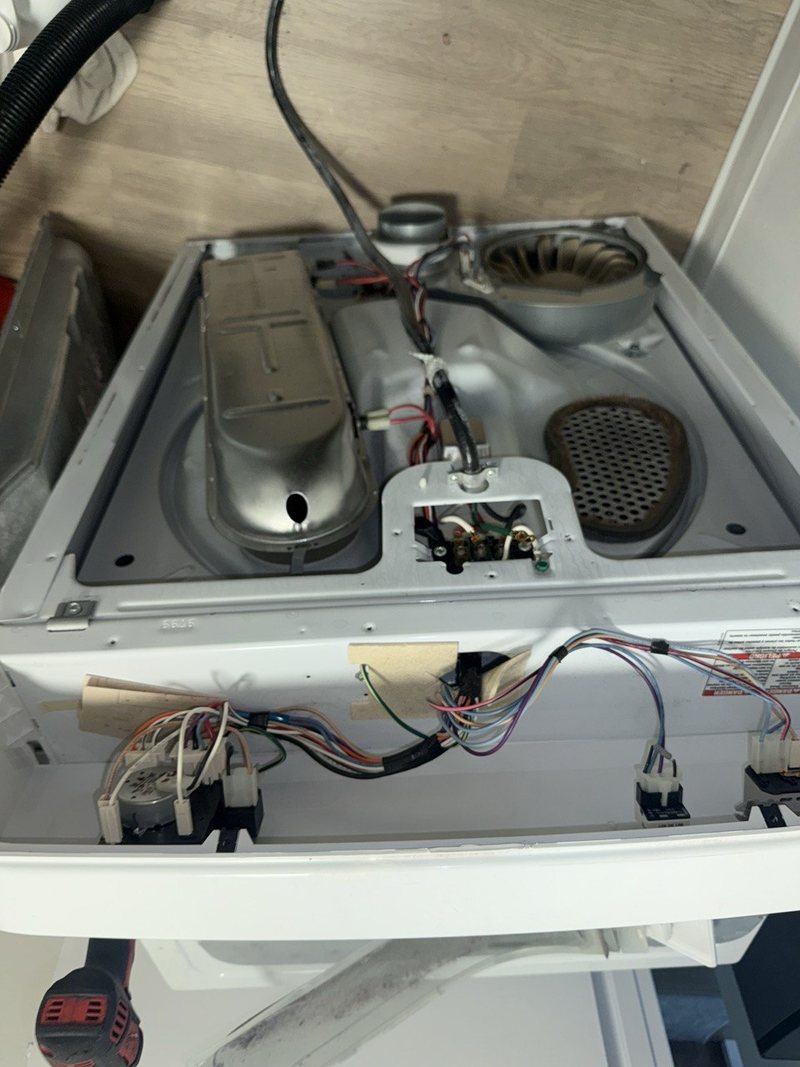
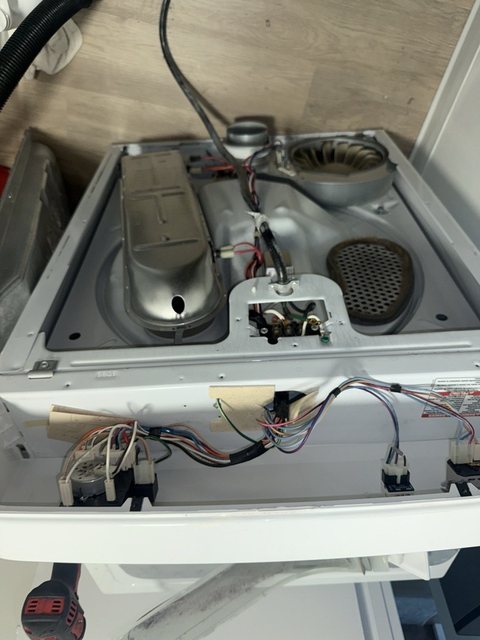
The technician starts the machine and goes outside to find the hood, if there is one. Airflow at the hood tells most of the story on a downtown dryer. Next the cabinet opens, back or front depending on the model, and the meter moves down the heat circuit: fuse first, the high-limit after it, the cycling thermostat next, and last the element (electric) or the igniter with its coils (gas). Gas burners are watched through a full ignition. A hand on the drum finds flat rollers, and a look at the belt finds glazing. A dryer in a closet gets pulled far enough to see the flex, which is usually crushed. Once the cause is pinned down, the part is named without jargon and the repair goes on paper as a single number.
The dryers in the downtown grid are Whirlpool, Kenmore, Maytag, GE and Amana, gas and electric, with Samsung and LG pairs in the redone bungalows and the occasional Speed Queen in a house whose owner bought it once and never again. Many belong to landlords: the tenant lets us in, a text with a photo of the failed part goes to the owner for approval, and the invoice, warranty written on it, lands in the owner’s inbox. People on Front St who leave for Boise before seven get the first stop. On every one, the repair gets its price after the $99 diagnostic, in writing, and saying yes means the $99 has already been absorbed into that figure.
Downtown Nampa dryer repair: $99 for the meter and the vent check, a sum that disappears into the written repair number once you approve, and is the full charge when you do not. Request service →
Asked in Downtown Nampa
My downtown Nampa dryer runs cold. What can I check before you come?
Look at the breaker; an electric dryer on one tripped leg turns without heating. Clean the lint screen and find the outside hood to see whether it opens when the dryer runs. If it is still cold after that, the fuse or element needs a meter.
Is the vent cleaned, or just the dryer fixed?
We clear the blower housing, whatever duct is reachable from the machine, and a crushed flex behind it, and we measure what comes out at the hood. A long rebuild of duct under a 1920s floor is a different job, and we say so instead of pretending.
A stacked pair in a Nampa rental closet: can you work on the dryer up top?
Yes. The dryer comes down for anything inside it, so we schedule the visit long enough and bring the second person when the closet is tight. Tell the dispatcher it is a stacked pair and whether the closet has a door that comes off.
Why did the thermal fuse open again a few months after it was replaced?
Because the vent is still restricted. The fuse protects the house from a dryer that runs too hot, and it opens whenever airflow drops far enough. A new fuse behind a packed thirty-foot duct is a repeat call, which is why we measure the hood every time.
How is dryer repair priced in the historic district?
The diagnostic is $99, spoken before the visit, and the repair figure follows the meter, on paper. Go ahead with it and the figure you signed off on already holds the $99. Pass on it and you owe $99, nothing more, with the vent reading and the failed part named on the invoice.
The phone is quicker; the form lands on the same desk. Both get you a text with a window, and until a technician has had a meter on the machine the only figure anyone quotes is $99.
Window texted to you; the technician will call if you would rather talk
$99 buys the meter reading and the diagnosis — no money before that
The repair as one written figure, $99 folded in
Warranty term printed on the invoice
How a visit runs
Four steps, and no step five on the invoice
1
Window
Ring the shop or fill in the form; dispatch answers with a window, and a text follows as the truck pulls off Davis Ave — first stops go to the Boise commuters, Saturday mornings to everyone else.
2
Meter
Measurements come before opinions: amps at the compressor, degrees on the shelf, ohms across the element. The failed part gets its everyday name from the technician, who then writes the repair as a single figure, $99 folded in.
3
Part
The shelves on the truck hold what this valley wears out — inlet valves, defrost heaters, heating elements, igniters, drain pumps, rollers. When something must be ordered, the return trip happens on our calendar and the figure you approved stands.
4
Proof
The machine runs a whole cycle while you watch, panels and floor go back the way they were, and the invoice that reaches your email carries the warranty term.
Dryers in Downtown Nampa — one written number, fixed once.
$99 puts a meter on the machine. The repair goes on the ticket as one figure with that $99 inside it, the part is usually riding in the truck, and the invoice states the warranty term. Parma pays what Davis Ave pays.