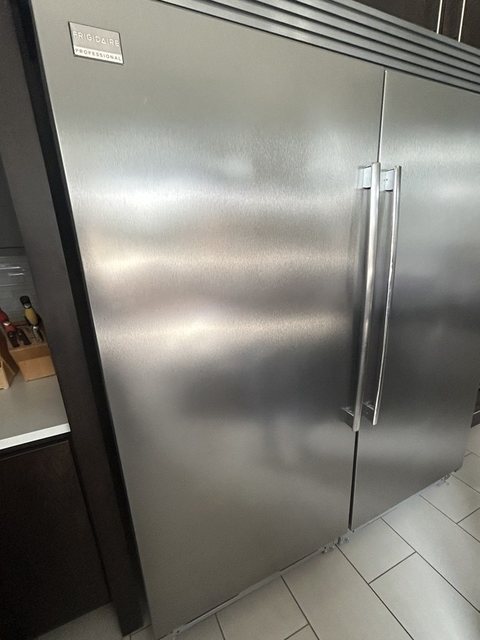
Refrigerators · freezers · garage units · Caldwell
Refrigerator repair in Caldwell before the food goes
Warm milk, a freezer full of frost, a compressor that clicks and quits: call Syringa before noon about a Caldwell refrigerator and the window is that same day.
$99 to diagnose — folded into the repair once you say yesON THE TRUCK Same-day for warm shelves12 MIN from Davis Ave · the drive never shows on the invoice
The truck reaches Caldwell up I-84 from Nampa and comes off at the 10th Avenue exit, then works the grid between the College of Idaho and Indian Creek Plaza before heading out Ustick and Middleton Rd to the newer subdivisions. The housing changes block by block. Near downtown and the college the kitchens belong to 1910s to 1950s houses, and the refrigerator is often the third one the room has held, wedged into an alcove built for a smaller box. Out past the rodeo grounds and along the Sunnyslope bench the calls are for garage refrigerators and chest freezers holding a season of beef and fruit.
July is the season. When afternoons sit above a hundred for two weeks, a condenser coil wearing a coat of dust and cottonwood fluff has nowhere to send its heat, the compressor stays on and gets hot, and the freezer creeps up from zero to twenty before anyone notices soft ice cream. A garage unit on the west wall of a house off Middleton Rd has it worse, because the garage itself is at a hundred and ten by four in the afternoon. Winter brings the opposite call from the same garages: a freezer that thawed because the fridge side never got warm enough to ask for cooling. Both end with a meter on the compressor and a plain answer.
What the symptom usually means
Fridge warm, freezer still cold
Nearly every time, defrost. Ice builds on the evaporator coil until air cannot get through, and the fresh-food side goes hungry. Defrost heater, bimetal or thermostat, control: each gets checked, the dead one gets swapped, and the coil gets cleared so the repair begins from bare metal.
Both sides warming
The compressor has stopped, or the condenser has no way to dump its heat. We read amperage at the compressor, test the start relay and overload, and feel the condenser. A clogged coil gets cleaned; a dead relay is replaced from the truck; a failed compressor gets a plain number so you can decide.
Compressor clicks every few minutes
A tripping start relay or overload, or a locked compressor pulling more amps than it can start on. A meter tells us which right away. Relays are on the truck. A locked compressor on an older Kenmore or Frigidaire usually means a replacement conversation, not a repair.
Water under the crisper drawers
A blocked defrost drain. Water from each defrost should travel down to the pan above the compressor, but a frozen or plugged drain sends it onto the fridge floor instead. Thawing and clearing it, checking the heater loop where one exists, and confirming flow is the fix.
Humming, rattling or a noisy fan
Condenser fans pick up dust from the gravel driveways out toward Sunnyslope, and the evaporator fan can ice up and scrape. We identify which fan, replace the motor, and check that the freezer is not frosting for a separate reason before we leave.
Runs oddly after a summer power blip
A thunderstorm brownout on the Idaho Power grid can leave the control board, or an inverter-driven compressor, confused, and some units never restart on their own. We test the board outputs and the inverter, reset what can be reset and replace what cannot.
The procedure
Temperatures read at the shelf and the freezer floor before anything is opened
Amperage at the compressor, voltage at the board, resistance across the heater
Failed part explained plainly, single written price with the $99 in it
Truck carries relays, heaters, thermostats and fan motors
Box confirmed cooling before departure, warranty written on the invoice
How refrigerator repair in Caldwell runs
The technician starts at the door with a thermometer, not a screwdriver. Shelf temperature, freezer temperature, and whether the compressor is running and pulling normal current tell most of the story before a panel comes off. From there it is one path or another: a frost pattern on the evaporator points at the defrost circuit, a hot compressor with a cold condenser points at a relay or a locked motor, a quiet unit with a lit display points at the board or the inverter. Each suspect gets metered, because a sensor reading wrong and a board reading wrong look identical on the display and are very different repairs. You get the answer standing at the kitchen counter, with the part named and the number written.
We repair Whirlpool, Maytag, Frigidaire, GE, Samsung, LG, Kenmore, Amana, KitchenAid, Bosch and Electrolux, including the side-by-sides in the college rentals and the French-door units that came with the newer houses off Ustick. For a rental near the College of Idaho or a second refrigerator in a shop building on the bench, the owner can approve by text from wherever they are with the photo, invoice and warranty arriving by email. A gate code or a loose dog belongs in the request. Approve, and that figure already has the $99 rolled into it; decline, and the entire charge is $99. No refrigerator repair in Caldwell gets a price until it has been metered, and then it gets exactly one, in writing.
Refrigerator repair in Caldwell is priced after the meter, never before. The $99 diagnostic dissolves into an approved repair; without one, $99 is where it ends. Request service →
Asked in Caldwell
Will a warm Caldwell refrigerator be seen today?
If the call comes in before noon on a working day, yes. A warm refrigerator jumps the route, since a day of waiting means a freezer’s worth of food in the trash. Afternoon calls get the first available window the next morning, and the dispatcher tells you which before you commit.
Should a garage refrigerator be repaired or replaced?
Repaired, usually, so long as the compressor is sound. In Caldwell a garage unit mostly dies of a dirty condenser, a tired relay or a defrost part, all ordinary repairs. When a fifteen-year-old compressor is the thing that failed, you hear that and the number, and many people replace at that point.
Why did my freezer thaw in January when the garage was cold?
A single-thermostat unit only runs the compressor when the fresh-food side gets warm. In a garage sitting at thirty-five degrees, that side never asks, so the freezer drifts up toward whatever the garage is. Some models accept a heater kit that fools the thermostat; we can tell you whether yours does.
Do you work on the old refrigerators in the houses near downtown Caldwell?
Yes. The 1950s and 1960s kitchens around the college and downtown hold plenty of twenty-year-old Kenmore and Whirlpool units, and they are worth a look because the parts are simple and often stocked. When a part is out of production, you find out before anything beyond the diagnostic is charged.
What does the $99 pay for on a refrigerator call?
It pays for a technician to meter the refrigerator at your house, name the failed part and put a repair price in writing. Choose the repair and its price already has the $99 buried in it. Pass, and $99 is your whole cost, with a written answer in hand rather than a guess.
Refrigerators and freezers in Caldwell: get a window.
The phone is quicker; the form lands on the same desk. Both get you a text with a window, and until a technician has had a meter on the machine the only figure anyone quotes is $99.
Window texted to you; the technician will call if you would rather talk
$99 buys the meter reading and the diagnosis — no money before that
The repair as one written figure, $99 folded in
Warranty term printed on the invoice
How a visit runs
Four steps, and no step five on the invoice
1
Window
Ring the shop or fill in the form; dispatch answers with a window, and a text follows as the truck pulls off Davis Ave — first stops go to the Boise commuters, Saturday mornings to everyone else.
2
Meter
Measurements come before opinions: amps at the compressor, degrees on the shelf, ohms across the element. The failed part gets its everyday name from the technician, who then writes the repair as a single figure, $99 folded in.
3
Part
The shelves on the truck hold what this valley wears out — inlet valves, defrost heaters, heating elements, igniters, drain pumps, rollers. When something must be ordered, the return trip happens on our calendar and the figure you approved stands.
4
Proof
The machine runs a whole cycle while you watch, panels and floor go back the way they were, and the invoice that reaches your email carries the warranty term.
Refrigerators and freezers in Caldwell — one written number, fixed once.
$99 puts a meter on the machine. The repair goes on the ticket as one figure with that $99 inside it, the part is usually riding in the truck, and the invoice states the warranty term. Parma pays what Davis Ave pays.