Towels still damp after an hour, a Caldwell dryer that tumbles cold, a squeal loud enough to carry down the hall.
$99 to diagnose — folded into the repair once you say yesON THE TRUCK No-heat calls within the week12 MIN from Davis Ave · the drive never shows on the invoice
Caldwell sits in the middle of working farmland, and the air proves it. Field dust in spring, chaff and cottonwood fluff in June, smoke and more dust in August, and every bit of it finds the dryer vent. On the Simplot and Darigold side of town, where a lot of households run laundry on shift schedules, a dryer can turn over two loads a day and a vent that was clear in March is half shut by fall. The 1910s to 1950s houses near the college and downtown add their own trouble: long vent runs through a crawlspace, foil hose that sags and traps lint, and a wall cap that has not opened in years.
The failure that follows is nearly always heat. When a vent backs up, an electric model blows its thermal fuse and every cycle after that is cold; on a gas dryer the igniter glows, the flame lights, and the high-limit thermostat kills it early so the drum spins for an hour and the load stays damp. Winter adds a twist in the subdivisions off Ustick and Middleton Rd, where the vent exits on a north wall and the moist exhaust freezes into a lint plug during a January inversion. The dryer gets fixed first, then the airflow gets measured so you are not calling about the same fuse in six weeks.
Reading a Caldwell dryer by its symptom
Tumbles but stays cold
For electric models the meter goes on the thermal fuse, then the element, then the cycling thermostat. For gas, the technician watches the burner window to see which of the three, igniter, sensor or coils, drops the light-off. The truck carries the part. The vent gets a look too, since a fuse seldom opens for no reason.
Heats, but takes two cycles
Airflow. Somewhere between the lint filter and the outside wall the duct has narrowed, or the blower wheel is packed, and moisture has no way out of the drum. The technician reads the exhaust at the wall cap, brushes out whatever is within reach, and says outright when the run itself is past cleaning.
Squeals, or thumps once a turn
The rear bearing, the idler pulley or the drum rollers have worn past their surface. A thump each revolution usually means a roller with a flat spot; a steady squeal points to the idler or bearing. Rollers and idler go in together on most models, so the noise does not simply migrate to the next worn piece.
Shuts off after a few minutes
The high-limit or the thermistor is reading hot because the exhaust cannot leave, or a motor with a worn centrifugal switch is dropping out under load. Sensors and motor get metered, and the vent gets checked before any part is named, because a good repair on a plugged vent lasts about a week.
Motor hums, drum sits still
With a broken belt the motor spins with nothing attached; with a seized roller or a jammed blower wheel it cannot turn at all. Belts and rollers are on the truck. When the motor itself has died, the meter says so, and the figure on paper is for a motor, not a belt and a hope.
Scorched clothes or a burnt smell
Either lint has piled up around the burner or element and started to char, or a dead cycling thermostat is letting the dryer overheat. Turn it off and leave it off. The heater housing gets cleaned out, the thermostat or element gets replaced, and the exhaust temperature is checked before anyone runs a load.
The procedure
Fuse, element, igniter, thermostats: metered, not guessed
Airflow read at the wall cap, never assumed from a clean filter
One figure on paper, the $99 diagnosis built into it
Truck stocked with fuses, elements, igniters, rollers and belts
Timed-dry cycle run with the panel on, warranty printed on the invoice
A Caldwell dryer repair visit, start to finish
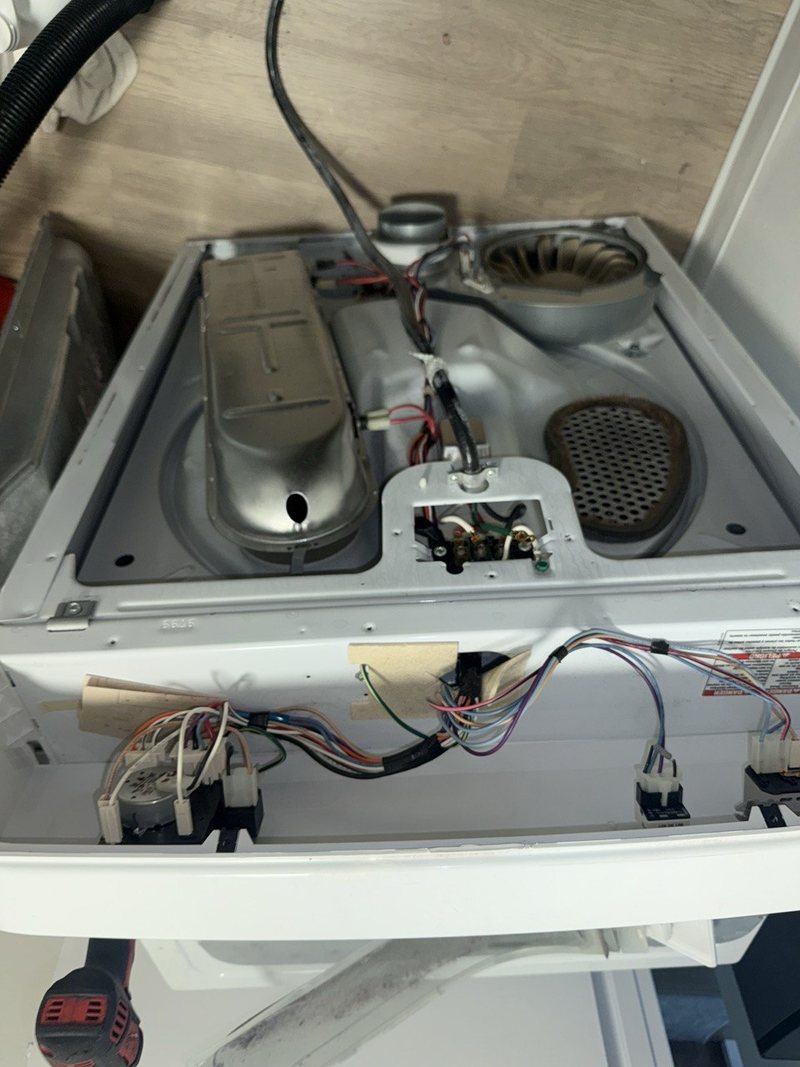
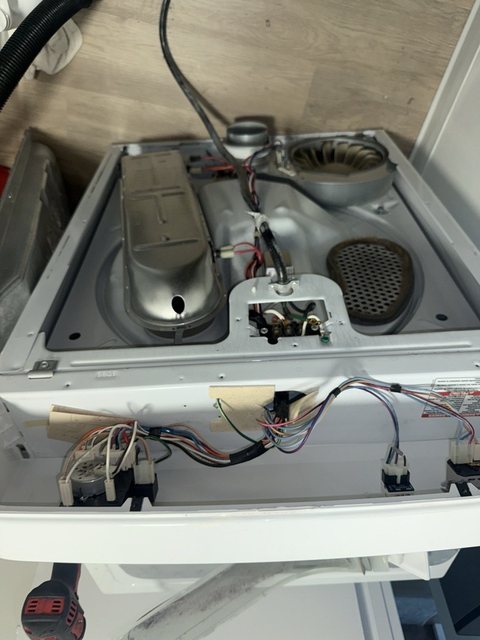
The suspect list for a cold dryer is short, and a meter works through it in minutes. The thermal fuse is either open or it is not. The element either has continuity or it does not. The igniter on a gas dryer either glows and lights or it glows and quits, which points at a flame sensor or the valve coils instead. The technician pulls the front or the back, meters each part in turn and names the one that failed. The vent comes next, because a fuse that opened once will open again if the exhaust still cannot get out. Airflow gets read at the wall, whatever duct the brush reaches gets cleared, and a crawlspace run that needs a duct cleaner or a rebuild gets called what it is.
Caldwell dryers carry the same nameplates as the rest of the valley: Whirlpool and Maytag most often, then GE, Samsung, LG, Frigidaire, Kenmore, Amana, Speed Queen and Electrolux, with the Whirlpool and GE builder pairs in the newer houses. A landlord with a duplex near the rodeo grounds can answer by text from wherever they are, the tenant handles the door, and the landlord’s inbox gets the invoice with its warranty line. Shift workers at the plants can ask for the first stop of the day or a Saturday morning. Whatever the model and whoever answers the door, you pay $99 to learn what failed, and if you go ahead that $99 lives inside the repair figure instead of above it. Choose not to go ahead, and $99 is the extent of it.
For a Caldwell dryer, finding the fault costs $99, and a yes rolls that $99 into the figure you approved. A dryer not worth saving costs you $99 and a plain explanation. Request service →
Asked in Caldwell
My dryer in Caldwell runs but never gets warm. What is it likely to be?
Electric: a thermal fuse or the heating element, about four times out of five. Gas: usually the igniter, sometimes the flame sensor. Each of those gets metered on the visit, and each is stocked on the truck. The fuse is the one that comes with a follow-up question about the vent, because it opens when air stops moving.
Do you clean dryer vents in Caldwell too?
Every heat call includes brushing out the duct from both ends, dryer side and wall cap, and reading the airflow before the truck leaves. A long run under a 1920s house or up through a two-story roof sometimes needs a dedicated duct cleaner with rods and a vacuum, and we tell you when that is the case instead of pretending our brush reached the end.
Is it worth fixing a gas dryer, or should I switch to electric?
A gas dryer with a bad igniter is an ordinary repair and worth doing. Switching means a new machine and, in the older houses near downtown, often a new circuit. Intermountain Gas is on most streets in town, so gas dryers are common here and their parts are simple. We fix what you have unless the drum or motor has gone.
Why does my vent freeze shut in winter?
Warm, wet exhaust hits a wall cap sitting at ten degrees and condenses on lint that is already sitting there, and the plug grows inward from the cap. A cap with a working flap and a short, smooth run helps; a sagging foil hose in a crawlspace makes it worse. Both get checked, and the fix that is not a dryer part gets pointed out.
What am I buying with the $99 in Caldwell?
A technician and a meter at your dryer, the part that quit named in words you can repeat, an airflow reading at the vent, and a repair figure on paper. A yes means the $99 was part of that figure all along. A no means $99 and the written diagnosis go home with you.
The phone is quicker; the form lands on the same desk. Both get you a text with a window, and until a technician has had a meter on the machine the only figure anyone quotes is $99.
Window texted to you; the technician will call if you would rather talk
$99 buys the meter reading and the diagnosis — no money before that
The repair as one written figure, $99 folded in
Warranty term printed on the invoice
How a visit runs
Four steps, and no step five on the invoice
1
Window
Ring the shop or fill in the form; dispatch answers with a window, and a text follows as the truck pulls off Davis Ave — first stops go to the Boise commuters, Saturday mornings to everyone else.
2
Meter
Measurements come before opinions: amps at the compressor, degrees on the shelf, ohms across the element. The failed part gets its everyday name from the technician, who then writes the repair as a single figure, $99 folded in.
3
Part
The shelves on the truck hold what this valley wears out — inlet valves, defrost heaters, heating elements, igniters, drain pumps, rollers. When something must be ordered, the return trip happens on our calendar and the figure you approved stands.
4
Proof
The machine runs a whole cycle while you watch, panels and floor go back the way they were, and the invoice that reaches your email carries the warranty term.
Dryers in Caldwell — one written number, fixed once.
$99 puts a meter on the machine. The repair goes on the ticket as one figure with that $99 inside it, the part is usually riding in the truck, and the invoice states the warranty term. Parma pays what Davis Ave pays.