Dryers · gas, electric and propane · South Nampa and Lake Lowell
Dryer repair in South Nampa when the tumble runs cold
A dryer that spins for an hour and hands back damp jeans, a burner that lights and dies, a thump from the laundry room.
$99 to diagnose — folded into the repair once you say yesON THE TRUCK Propane and natural gas burners8 MIN from Davis Ave · the drive never shows on the invoice
Dryers south of town come in two kinds of houses. The subdivisions along Greenhurst Rd, Southside Blvd and the streets between them were built in the 1990s and 2000s with a ground-floor laundry room and a short vent, and the dryers are the electric Whirlpools and GEs that came with the house. Out along Lake Lowell Ave and down 12th Ave Rd toward the refuge, the farmhouses and the newer acreage builds run gas dryers off a propane tank out back, and the vent may run thirty feet under a porch. The truck heads south from Davis Ave and covers both before lunch on a normal day.
Out here the vent is the dryer’s weak point. Dust from the orchards, the fields and the gravel drives fills the duct and the housing behind the lint screen, and a dryer on a plugged vent runs long, overheats and blows its thermal fuse. Propane units switched over from natural gas with the wrong orifice burn yellow and soot the drum, and a propane burner that lights and drops out after ten seconds is a flame sensor or a coil that the meter finds fast. In the Greenhurst subdivisions the calls are plainer: worn rollers, a belt that snapped, an element that finally opened after fifteen years of loads.
The symptom and what is usually behind it
No heat, drum still turning
Electric: something in the heat circuit has opened, element, fuse or high-limit, and the meter shows which. Propane or natural gas: igniter, sensor or coils. The failed piece gets replaced, then we chase the cause, because a fuse that blew from a plugged vent will blow again if the vent is left alone.
Full cycle, jeans still damp
Low airflow. The duct is packed with dust and lint, the outside flap is stuck shut, or the blower wheel is slipping on the shaft. We measure the air at the exhaust, clear the reachable run, and tell you if the long run under the porch needs a full clean-out.
Propane burner lights, then goes out
The flame sensor is not proving the flame, or one of the valve coils has weakened and drops out under heat. Both are resistance checks. If the burner is yellow and sooty, the orifice for propane was never installed at conversion, and we correct that as part of the repair.
Loud squeal or thump every rotation
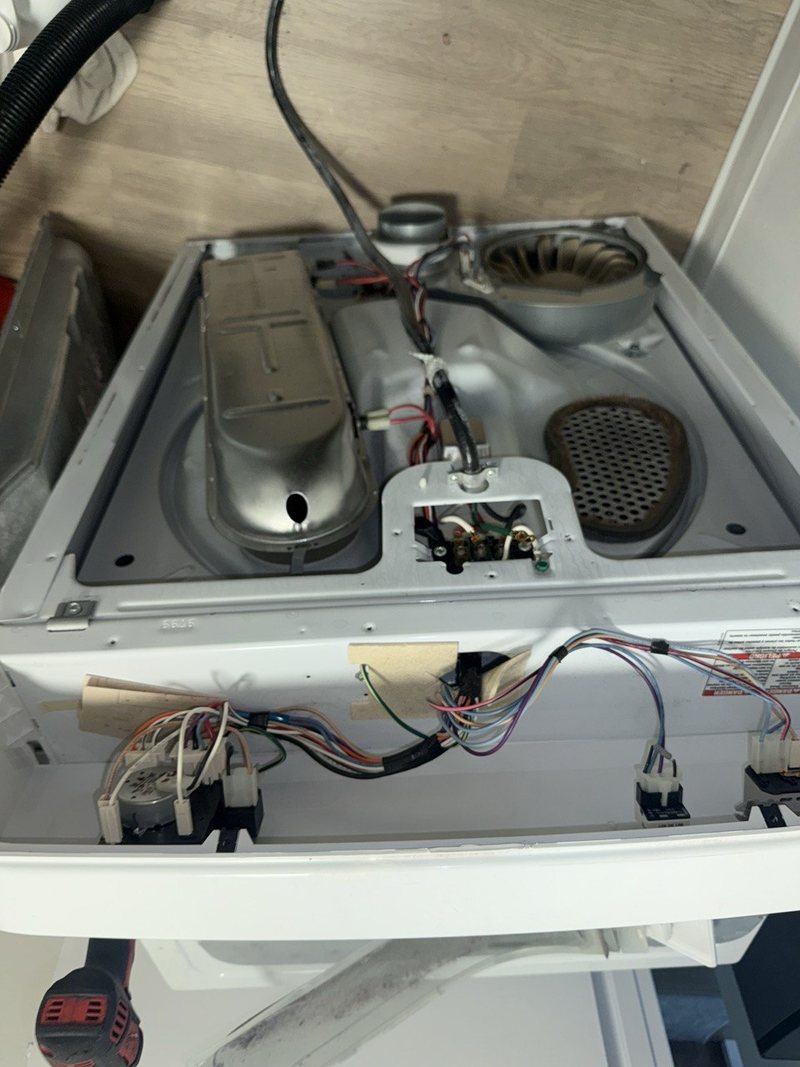
Rollers, glides or the idler pulley are worn flat, or something small is riding in the blower. We open the cabinet, lift the drum, and turn each roller by hand. The set gets replaced together with the belt so the same noise does not come back in six months.
Dryer runs, then quits partway through
A motor overheating from a plugged blower, a thermal fuse opening on heat, or a door switch that lets go when the drum vibrates. The vent gets measured first. Then the motor windings, fuse and switch each get the meter. A motor is quoted only when the meter says it is the motor.
Burnt smell, brown mark on the clothes
Lint has built up in the heater box or at the burner and is starting to scorch. Stop using it. The drum comes out, the heater box and blower housing get cleaned, the element gets checked for a sag against the cabinet, and the vent gets cleared. On the acreage this is nearly always a dust problem in the duct.
The procedure, propane or plug-in
Airflow checked at the exhaust before the cabinet is opened.
Element, fuse, thermostats, igniter, sensor and coils read on the meter.
Plain name for the failed part, and one written figure that already includes the $99.
Elements, igniters, coils, rollers, belts and fuses stocked for the brands we see most.
Timed drying cycle, burner watched through a full run, written warranty on the invoice.
Dryer repair in South Nampa, meter first
A dryer visit starts at the vent, because the vent explains most of what a dryer does wrong. The technician runs the machine and checks the airflow at the exhaust and at the outside hood. After that the panels come off so the meter can run the whole heat path: element and fuses on electric, igniter, flame sensor and valve coils on gas and propane. A drum complaint means the drum comes out and each roller gets turned by hand along with the idler. On a propane dryer the flame gets a look for color, because a yellow flame is a conversion done wrong. When the culprit has a plain name, the repair goes down in writing as a single figure, $99 included.
Speed Queen, Whirlpool, GE, Maytag, LG, Samsung, Electrolux, Frigidaire, Kenmore and Amana dryers are all regular work, and we handle propane burners as readily as natural gas. The farm-labor housing and the second homes near the lake are worked by text with the owner, who approves the written number and gets the photo, invoice and written warranty by email. Gate codes and dogs go in the request. Dryers get a same-week slot, often the next day, with the first stop of the morning held for people who drive to Boise and Saturday mornings for everyone else. No repair gets a price until the meter has been on it, and the price arrives in writing with the $99 already absorbed; say no and the visit ends at $99.
Every dryer repair in South Nampa and the Lake Lowell acreage is priced after the $99 diagnostic, in writing, and approving the number means the $99 has already been counted in. Request service →
Asked in South Nampa & Lake Lowell
Do you work on propane dryers out past Lake Lowell?
We do. A lot of the acreage south of Lake Lowell Ave cooks and dries on propane, and the truck carries burner parts for the brands out here. If a dryer was converted from natural gas and burns yellow, that is corrected in the same visit, because a sooty burner is both a heat problem and a laundry problem.
My South Nampa dryer keeps opening its thermal fuse. Why?
Because the vent is plugged, almost every time. A fuse opens when the heater box runs hot, and it runs hot when air cannot get out. A new fuse over a plugged duct lasts a few weeks. We measure the airflow and clear the run before the new fuse goes in.
Is a worn roller worth fixing on a fifteen-year-old dryer?
Usually. Rollers, an idler and a belt are a modest repair and a dryer that old is otherwise a simple machine. The technician gives you the one written number and tells you if the motor or the element reads like it is close behind, so you can decide with everything in front of you.
Can you come to a farmhouse with a long driveway and a gate?
Yes, and there is nothing for the drive on the invoice. Put the gate code, the dog, and where the dryer is in the request. If the laundry is in an outbuilding with a long vent run under a porch, say that too, so the technician brings the longer brush.
On a South Nampa dryer call, what is the $99 buying?
Meter work and an airflow reading at your machine, a plain name for the failed part, and a written repair figure. Approve, and the diagnostic $99 sits within that figure rather than above it. Should you turn it down, the total stops at $99 and the dryer is left closed up.
Dryers in South Nampa and Lake Lowell: get a window.
The phone is quicker; the form lands on the same desk. Both get you a text with a window, and until a technician has had a meter on the machine the only figure anyone quotes is $99.
Window texted to you; the technician will call if you would rather talk
$99 buys the meter reading and the diagnosis — no money before that
The repair as one written figure, $99 folded in
Warranty term printed on the invoice
How a visit runs
Four steps, and no step five on the invoice
1
Window
Ring the shop or fill in the form; dispatch answers with a window, and a text follows as the truck pulls off Davis Ave — first stops go to the Boise commuters, Saturday mornings to everyone else.
2
Meter
Measurements come before opinions: amps at the compressor, degrees on the shelf, ohms across the element. The failed part gets its everyday name from the technician, who then writes the repair as a single figure, $99 folded in.
3
Part
The shelves on the truck hold what this valley wears out — inlet valves, defrost heaters, heating elements, igniters, drain pumps, rollers. When something must be ordered, the return trip happens on our calendar and the figure you approved stands.
4
Proof
The machine runs a whole cycle while you watch, panels and floor go back the way they were, and the invoice that reaches your email carries the warranty term.
Dryers in South Nampa and Lake Lowell — one written number, fixed once.
$99 puts a meter on the machine. The repair goes on the ticket as one figure with that $99 inside it, the part is usually riding in the truck, and the invoice states the warranty term. Parma pays what Davis Ave pays.